Mira Patodia ’26
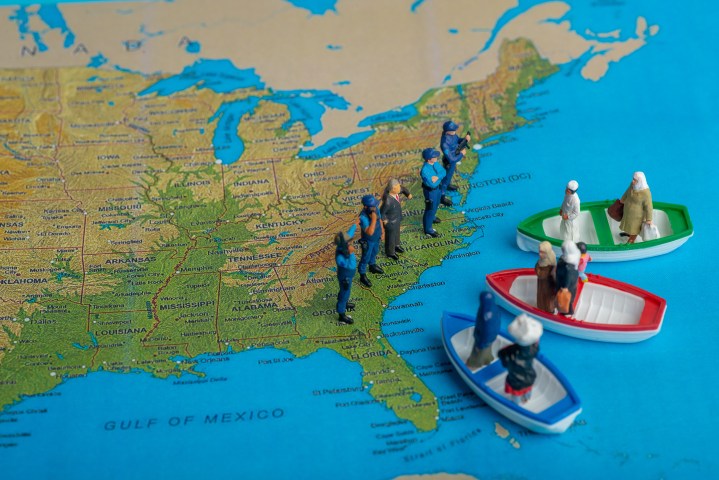
Islamophobia has risen and transformed dramatically in recent years. Many of the direct discrimination and hatred against Muslims that appear in today’s society did not exist until the 21st century. However, more recently, the prejudice and discrimination Muslim people in America face has grown exponentially. After 9/11, public opinion about Muslim people became increasingly hostile, and especially throughout Donald Trump’s presidency, these negative opinions only became worse. In the wake of the ongoing conflict between Israel and Palestine, many Muslims in the United States are facing extreme discrimination.
Before anti-Muslim sentiments became common, Muslims had already been living in the United States for a long time. The first known arrival of Muslims to the states was in the 17th century when enslaved people from Africa arrived in the U.S. Many of these enslaved Africans were Muslim. Although they were not permitted to practice religion as enslaved people, many did privately and passed their Islamic faith down to their children and beyond. Throughout the rest of the 19th and 20th centuries, more and more Muslim immigrants came to the U.S. The Immigration and Nationality Act, which abolished numerical quotas on immigration and began to utilize a system that prioritized the skills of the immigrants and their relation to current U.S. residents, was created in 1965.1 This act, although still showing preference towards specific groups of people, allowed many Muslims from the Middle East and South Asia to immigrate to the United States.2
The term “Islamophobia” refers to hostility and discriminatory practices perpetuating racial and xenophobic ideas about Muslims. In the modern-day United States, it can be found everywhere, perpetuated by both media entities and the prejudices of individuals. One of the catalysts for negative media coverage of Muslims in the U.S. was the Iranian Revolution of 1979. Directly after Iran was declared an Islamic Republic, Iranian protesters seized the U.S. embassy in Tehran and detained and held hostage more than 50 Americans for over a year.3 As a result, Islam became linked to these detainments. Throughout the 1980s, more of the general population began associating stereotypical images of terrorists with Muslims. In addition to the public opinion against Muslims, legislation began to pass discriminating against Muslims, including bills like the Antiterrorism and Effective Death Penalty Act, which led to the investigation and deportation of many Muslims who were thought to be associated with terrorist groups (even if they were not actually associated with them).4
After September 11, 2001, Islamophobia drastically increased and transformed entirely in the United States. Following 9/11, many more hate crimes were committed against Muslim people. From 2000 to 2001, hate crimes against Muslims grew 1617%, marking some of the largest numbers of Islamophobic hate in history. In an interview with ABC, Representative Ilhan Omar, who is Muslim, said, “There is a desire by many to use our faith and our identity as a weapon against us and to ‘other’ us.”5 According to a Pew Research poll, directly after 9/11, 40% of Americans had negative attitudes toward Muslims, and many believed that Islam was fundamentally associated with violence, war, and terrorism. Furthermore, the aftermath of 9/11 was a turning point that led to more anti-Muslim legislation.
In 2015, anti-Muslim rhetoric began to spread even further as former president Donald Trump made the Islamic faith and Muslims a target throughout his campaign and presidency. Around this time, Trump called for a complete ban on Muslims entering the United States. Once he became president, he signed an executive order preventing several countries with a majority-Muslim population from immigrating to the U.S. As a result, throughout the time this ban existed, around 40,000 people were refused visas and could not immigrate to the United States. Trump also made many comments saying that mosques were suspicious and needed to be investigated. However, his claims were never backed up with any evidence.6 In general, possibly in part due to Trump’s anti-Muslim rhetoric, most Republican-leaning Americans share unfavorable opinions toward Muslims. As of August 2021, 72% of Americans who lean Republican politically believe that Islam is more likely than any other religion to encourage violence, a statistic that has been increasing for the past 20 years.7
Recently, the events in Israel and Palestine have led many Palestinian Americans, in addition to other Muslims living in the United States, to see a rise in Islamophobic attacks against their communities. These attacks range from instances of vandalism and bullying to physical harm and even murder. In New York City, a man wearing a turban and mask was punched on a bus, and in Dearborn, Michigan, a town that is 42% Arab, a man was arrested for making threats of violence against Palestinian Americans.8 In Plainfield Township, Illinois, a six-year-old Palestinian boy named Wadea Al-Fayoume was fatally stabbed and killed. His mother was also critically injured. The police have stated that these two were targeted due to their ethnicity and religion. In addition to in-person hate, online hate has grown over these past weeks. The unregulated online platform 4chan saw a 479% increase in anti-Muslim and anti-semitic slurs since the beginning of the conflict.9
Aber Kawas, a member of the US campaign for Palestinian rights, told CNN, “Palestinian Americans and Muslim Americans feel like they are experiencing the level of hate and Islamophobia that existed after 9/11 and during the Iraq war – some say it’s even worse.” Hatred against Muslim people has grown exponentially over the past years and has only intensified following the outbreak of the Israel-Gaza war.
Notes:
- https://www.lbjlibrary.org/news-and-press/media-kits/immigration-and-nationality-act#:~:text=The%20Immigration%20and%20Nationality%20Act%20abolished%20quotas%2C%20opening%20the%20doors,President%20John%20F ↩︎
- https://www.learningforjustice.org/magazine/publications/what-is-the-truth-about-american-muslims/american-muslims-in-the-united#:~:text=The%20history%20of%20American%20Muslims,arrival%20of%20slaves%20from%20Africa. ↩︎
- https://history.state.gov/departmenthistory/short-history/iraniancrises ↩︎
- https://www.ncbi.nlm.nih.gov/pmc/articles/PMC5055770/ ↩︎
- https://abcnews.go.com/US/20-years-911-islamophobia-continues-haunt-muslims/story?id=79732049 ↩︎
- https://www.cnn.com/2017/11/29/politics/donald-trump-muslim-attacks/index.html ↩︎
- https://www.pewresearch.org/politics/2021/09/02/two-decades-later-the-enduring-legacy-of-9-11/#views-of-muslims-islam-grew-more-partisan-in-years-after-9-11 ↩︎
- https://www.cnn.com/2023/10/17/us/us-palestinians-muslims-fear-islamophobia-surge-reaj/index.html ↩︎
- https://time.com/6324995/muslim-jewish-hate-crimes-israel-hamas-war/ ↩︎


Leave a Reply