Sebastian Lemberger ’25
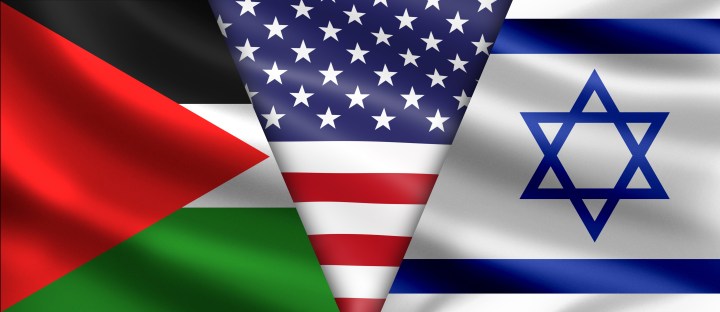
One-line Summary: The Israel-Gaza war puts the US in a difficult position in which it must both maintain stability in the Middle East and prevent the genocide of Palestinians.
The question of how to end the Israeli-Palestinian conflict is hotly debated, but the idea of a two-state solution is generally thought to be one of the better outcomes of altercations between the two nations. Due to the fundamental imbalance of power between Israel and Palestine in the status quo, any reality in which a two state-solution occurs would require the US, UN, and other global powers to ensure that this transition does not inordinately favor Israel, which currently holds power over both Gaza and the West Bank. However, following the outbreak of the Israel-Gaza war, the US has shown unconditional support for Israel on the global stage, blocking it from being held responsible for civilian casualties in the UN and initiating the delivery of an aid package to the country.1 The first step for any U.S. involvement in a two-state solution would require it to de-escalate Israeli military involvement with Palestine. However, due to tensions in the Middle East as well as the US’ own interests, weakening support for Israeli military operations could have potentially harmful repercussions for both the US and the region at large. This ultimately places the US in an impossible predicament where both bolstering and weakening Israeli military efforts could have potentially harmful repercussions for the area.
The primary issue with US relations with Israel staying the way that they are is that it encourages Israel’s current methods of military response against Palestine. Since its rise to power in Gaza, Hamas has repeatedly attempted attacks on targets in Southern Israel, which have resulted in retaliation from Israel in the form of military responses like Operation Cast Lead and Operation Pillar of Defense.2 While these retaliations were technically justified under international law due to Hamas’ instigation of the conflict, Israel’s responses to these attacks have all taken massive tolls on the inhabitants of Gaza. 2014’s Operation Protective Edge, for instance, killed 1,462 Palestinian civilians in comparison to 73 dead Israelis.3 While these bombardments have been excused under international law in the past, Israel’s recent bombardment of Gaza, coupled with measures like cutting utilities and forming a blockade around the strip, are even more problematic, as it could be considered attempted genocide. In an interview with the Washington Post, Moreno Ocampo, a human rights lawyer, stated, “The problem is that the response from Israel … it’s complicated. Just the blockade of Gaza — just that — could be genocide under Article 2(c) of the Genocide Convention, meaning they are creating conditions to destroy a group.”4 If the U.S. supports Israel unconditionally, shielding it from international criticism as it has done in the UN, the U.S. is abetting the massacre of Palestinian civilians. While Biden has encouraged his Israeli allies to minimize civilian casualties, US support of Israel has not wavered even as the blockade and bombardments have continued.
At the same time, while the United States needs to ensure that Israeli retaliation against Hamas does not result in massive civilian casualties, its support of Israel is also necessary to maintain order in the Middle East. As a Jewish nation occupying land that is considered holy in all Abrahamic religions, Israel’s very existence provokes the ire of its Islamic neighbors, who, until the Trump administration’s 2020 Abraham Accords, did not recognize it as a country.5 Israel has been attacked on numerous occasions by its neighbors over territory in conflicts like the Yom Kippur War. Although the situation has improved somewhat in the past few years, Israel has few friends among its neighbors. As such, the US backing of Israel is necessary to maintain peace in the region, as the US has historically endeavored to mediate regional conflict.
Regarding the Israel-Gaza War, while US solidarity for Israel will not meaningfully affect the military nature of the conflict, it will serve as a deterrent for other actors in the Middle East who might seek to capitalize on the fighting. In particular, Iran and Hezbollah (an Iranian-backed militant group run out of Lebanon) pose major concerns for Israel, as IDF soldiers are already exchanging fire with Hezbollah on the border to Lebanon.6 The US backing of Israel is also essential to risk mitigation within the region, as Iran and other Middle Eastern actors’ rivalries with Israel have the potential to escalate fighting beyond the scope of Gaza. All-out war in the Middle East could prove deadly for Israel, and the destruction of the world’s only Jewish sovereign nation is not something the US can afford to let happen. Furthermore, the US needs to protect Israel out of its own self-interest due to it being its only major ally in the region.
The Israel-Gaza puts the US in a tricky position where it must stop two scenarios that would both result in massive loss of human life. If the US allows the IDF to continue its blockade and bombardment of the Gaza Strip, thousands more Palestinian civilians could be killed in Israel’s quest to eradicate Hamas. However, the US must balance any steps that it takes to stop a potential genocide in the Gaza Strip with its need to show solidarity for Israel and deter any larger-scale conflict in the region. No matter what, the Israel-Gaza War will bring unnecessary casualties, which it is the US’ duty to mitigate.
Notes:
- https://apnews.com/article/un-security-council-resolution-gaza-hamas-1c23913f8552f5379b2c158a83493835 ↩︎
- https://www.washingtonpost.com/world/2023/10/20/israel-hamas-war-crimes-gaza-justice-genocide-international-criminal-court/ ↩︎
- https://www.bbc.com/news/world-middle-east-28439404 ↩︎
- https://www.washingtonpost.com/world/2023/10/20/israel-hamas-war-crimes-gaza-justice-genocide-international-criminal-court/ ↩︎
- https://thehill.com/policy/international/4267110-israel-hamas-major-test-abraham-accords/ ↩︎
- https://www.nytimes.com/2023/10/23/opinion/gaza-hamas-hezbollah-iran.html ↩︎



Leave a Reply